If you’ve been trying to decide between investing in traditional signage or Digital Out-of-Home advertising, you’re asking a reasonable question — but it might be the wrong one. The businesses that build the strongest local visibility aren’t choosing between these two formats. They’re using each one for what it does best, and letting them reinforce each other.
This article breaks down how static signage and DOOH actually work, where each format performs strongest, and how combining them creates a visibility strategy that’s greater than either one alone. If you’re a small or mid-sized business thinking seriously about your physical presence in your market, this is worth understanding before you make your next investment.
What Traditional Static Signage Does Well
Static signage — vinyl billboards, building-mounted displays, window graphics, trade show backdrops, banners — has one defining strength: it never stops working. Once it’s installed, it’s there. Every person who drives that road, walks that block, or passes that building sees it, day after day, without any ongoing spend required.
That consistency is powerful in ways that are easy to underestimate. Brand recognition is built through repetition. When the same colors, logo, and message appear in the same physical location over months and years, they become embedded in the mental map of everyone who regularly passes through that area. This is how local businesses become landmarks — not through any single campaign, but through steady, uninterrupted presence.
Think about a dental practice that’s been in the same building for eight years with consistent exterior signage. They’re not running awareness campaigns anymore — the neighborhood already knows they exist. That recognition was built slowly and cheaply, one commute at a time.
Static signage is the right tool when your message is stable, your location is fixed, and your goal is long-term presence rather than short-term response. It’s the foundation of physical visibility — and like any foundation, it works best when something is built on top of it.
What Digital Out-of-Home Advertising Does Well
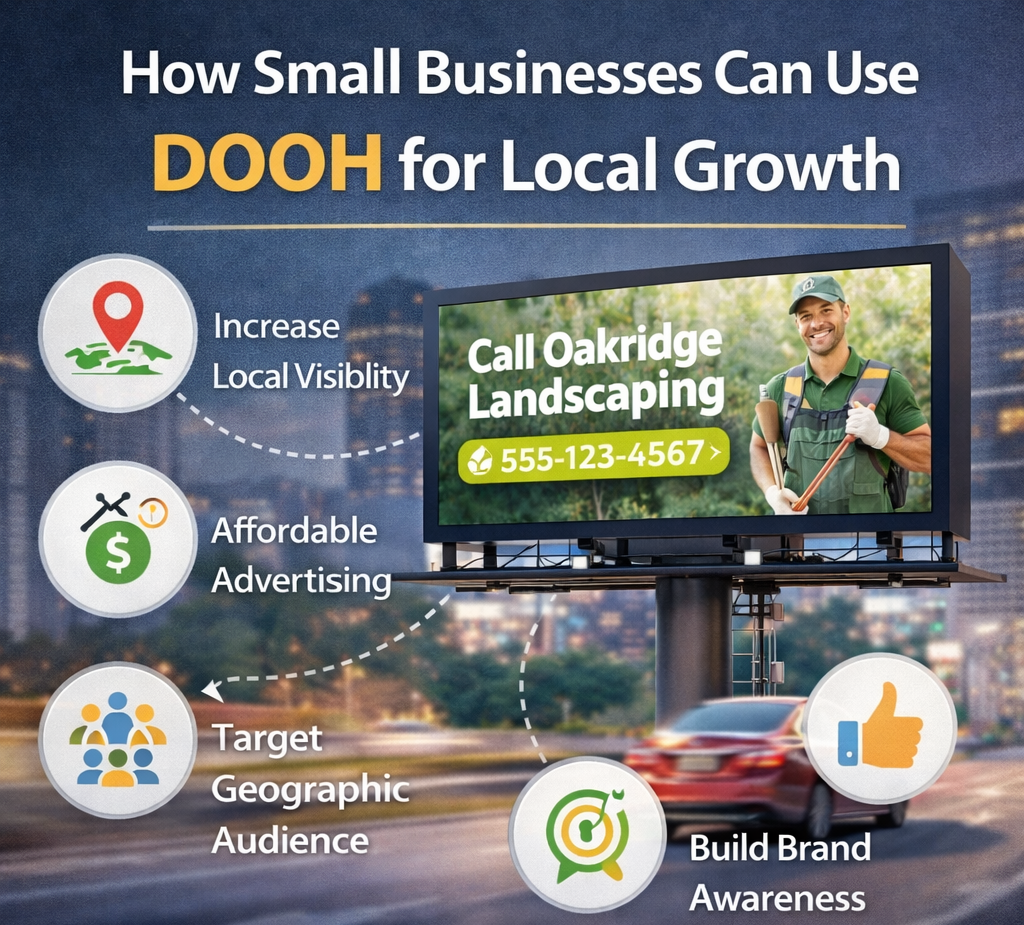
DOOH operates differently. Digital displays in high-traffic environments — along commuter corridors, in commercial districts, near retail centers — rotate multiple advertisements within programmed time slots. You’re buying scheduled exposure rather than permanent presence, which changes what the format is useful for.
The defining advantage of DOOH is flexibility. You can run a campaign for two weeks or two months. You can change the creative without reprinting anything. You can schedule your ad to appear during morning commute hours when your target audience is most likely to be on that road. You can test a message in one geographic area before committing to it more broadly.
That flexibility makes DOOH particularly effective for specific, time-bound objectives — a grand opening, a seasonal promotion, a new service launch, an expansion into a neighborhood where you don’t yet have brand recognition. It puts your message in front of a large local audience quickly, without the lead time and logistical coordination that static signage requires.
DOOH also integrates more readily with your digital measurement. Because campaigns run within defined windows, you can look at correlated changes in branded search traffic, direct website visits, and inquiry volume during and after a campaign period. That gives you a clearer picture of what’s working than static signage typically allows.
Where Businesses Go Wrong: Treating Them as Substitutes
The most common mistake businesses make with out-of-home advertising is treating these formats as alternatives — picking one or the other based on budget, familiarity, or whatever a vendor happens to be selling that month. The result is usually a visibility strategy that’s either too static to respond to opportunities or too campaign-driven to build lasting recognition.
A home services company that only runs DOOH campaigns might generate spikes of awareness around each campaign, but in between those windows, they have no physical presence in their market. A competitor with strong static signage is quietly building recognition every day those digital campaigns aren’t running.
On the other side, a business that only invests in static signage has a solid foundation but no mechanism for responding to seasonal demand, competitive pressure, or growth opportunities. They’re visible, but not agile. When a new competitor opens nearby or a key promotion window comes around, they have no fast-response tool to deploy.
How the Two Formats Work Together
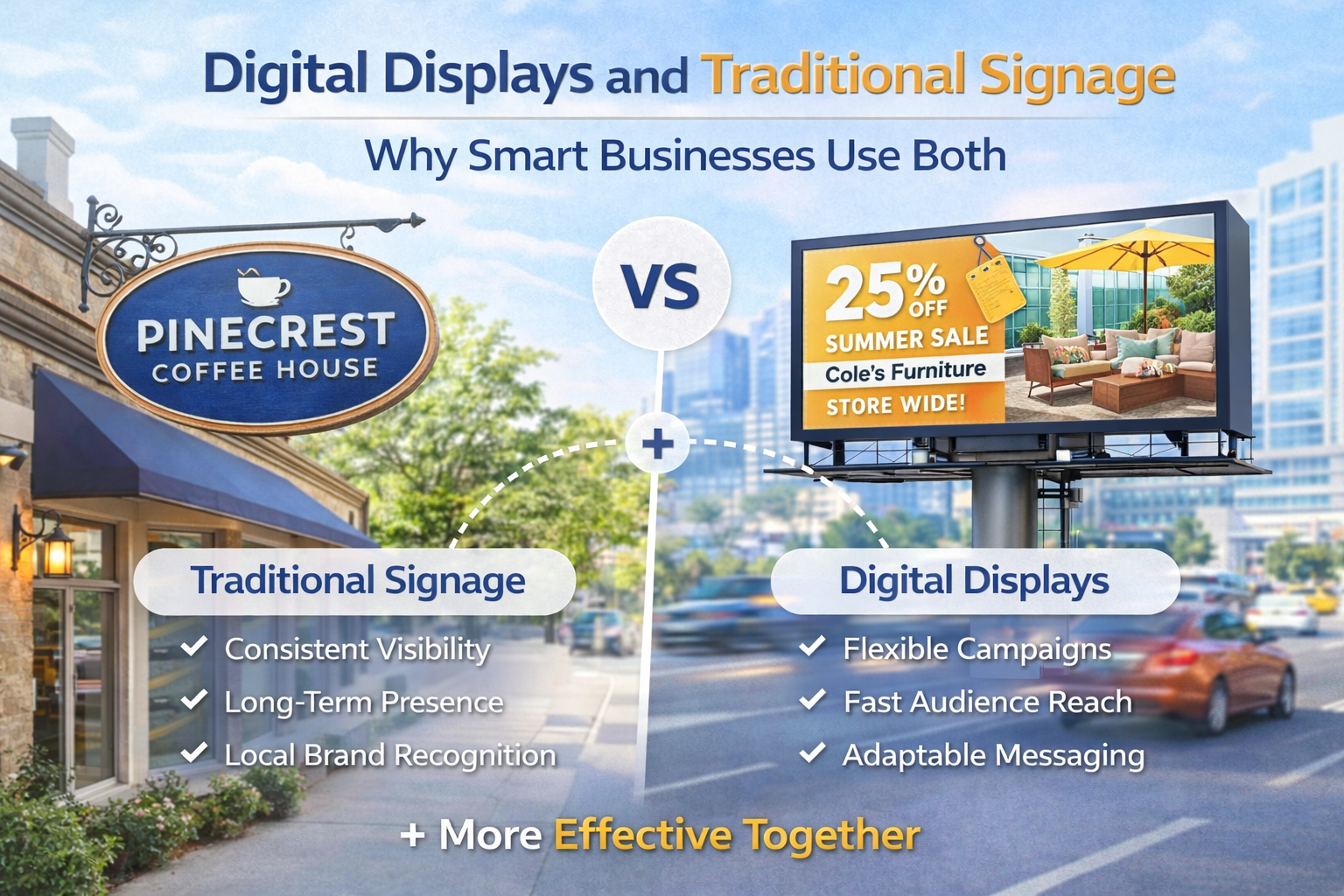
When static signage and DOOH are used in combination, each format strengthens the other in ways that neither achieves alone.
Static signage builds the baseline. It establishes your presence in a geography, reinforces your brand identity through repetition, and creates the foundation of recognition that makes every other marketing effort more effective. When someone sees your DOOH campaign on their morning commute, they’re far more likely to respond if they’ve already been seeing your storefront signage for months. Familiarity accelerates action.
DOOH activates that foundation at key moments. A grand opening, a seasonal campaign, a new service, an expansion into a new neighborhood — these are moments when you want to reach beyond your existing audience and generate immediate response. DOOH delivers the scale and speed that static signage can’t.
Consider a local med spa that has consistent exterior signage on a well-traveled street. They’re known in the immediate area, but they want to reach a broader audience for their spring promotion. A two-week DOOH campaign on two nearby commuter corridors puts their brand in front of thousands of people who weren’t already passing their door — and because the visual identity matches their signage exactly, the recognition transfers. By the time those commuters drive past their building, it already feels familiar.
That’s the compounding effect of a coordinated visibility strategy. Each format does its job, and the consistency between them makes both more effective than they would be independently.
Knowing When to Use Each Format
A useful way to think about this: static signage is your always-on presence, and DOOH is your activation tool. Here’s how that plays out in practice.
Reach for static signage when: your message is stable and doesn’t need to change frequently, you have a fixed location you want people to associate with your brand, or you’re building long-term recognition in a geography where you operate permanently. Storefront signage, building displays, long-duration billboard placements, and trade show backdrops all fall into this category.
Reach for DOOH when: you have a time-sensitive message, a defined campaign window, or a specific geographic area you want to penetrate quickly. Grand openings, seasonal promotions, new service launches, competitive responses, and market expansion initiatives are all strong DOOH use cases.
Use both when: you want the kind of market presence that compounds over time — a steady baseline of recognition that amplifies the impact of every campaign you run on top of it. This is the approach that makes a business feel established and visible regardless of the season or the competitive environment.
Making It Work: Consistency Across Both Formats
One practical note that matters more than most businesses realize: the visual consistency between your static and digital placements is what makes the combined strategy work. If your DOOH campaign uses slightly different colors or a different version of your logo than your physical signage, you’re diluting the recognition effect rather than compounding it.
This is one of the real advantages of working with a single partner across both formats. When the same team is producing your static signage and your digital campaign creative, consistency is built in rather than something you have to coordinate and verify across separate vendors. The brand stays tight, the message stays aligned, and you’re not managing two separate relationships every time you need to update something.
It’s a small operational detail that makes a meaningful difference to how your visibility strategy performs over time.
Ready to Build a Visibility Strategy That Works Year-Round?
The businesses that win in their local markets aren’t the ones that make the biggest single investment in visibility — they’re the ones that show up consistently, respond to opportunities quickly, and make sure every customer touchpoint reinforces the same identity. Static signage and DOOH, used together with discipline and consistency, are two of the most effective tools available for doing exactly that.
At Black Cellar Market, we handle both. Whether you’re building out your foundational signage, planning a campaign around a key moment in your business calendar, or thinking about how to coordinate both into a cohesive strategy, we’re set up to support the full picture. You work with one team, maintain one consistent brand, and have a partner who understands how each piece connects to the others.
If you’d like to talk through what a visibility strategy could look like for your business, reach out to the Black Cellar Market team. We’d be glad to hear where you are and where you’re headed.